Attenuation
A VHF or UHF signal loses strength extremely quickly in rock. A few metres of limestone can do what kilometres of open air would not, and the loss gets worse as frequency rises. That is exactly the direction useful data rates lie in.

Why underground communication is hard, and what LoCave does about it.
A VHF or UHF signal loses strength extremely quickly in rock. A few metres of limestone can do what kilometres of open air would not, and the loss gets worse as frequency rises. That is exactly the direction useful data rates lie in.
Cave passages bend, pinch, drop and double back. Even where a signal would travel, there is rarely a straight path between two points for it to travel along.
Very low frequency systems genuinely do pass through rock. They do it over modest depths, with substantial gear at both ends, and with no way to extend the link as the team moves. A line laid along the passage has none of those limits.
LoCave does not try to beat physics. It splits the job in three: fibre between nodes where distance matters, LoRa radio (433 MHz) between nodes where fibre is not laid, and Wi-Fi where the people are.
At a node the network becomes ordinary Wi-Fi. A caver’s phone joins it and opens the chat page the node hosts: no pairing ritual, no dedicated radio to train on, nothing extra to carry beyond what is already in a pocket. A sent message shows a tick once the gateway has it.
The range of any one node is a pocket, not a blanket. That is deliberate. Covering a chamber with short-range radio is cheap and dependable; covering a whole cave system with radio alone is neither.
Between nodes the signal runs on optical fibre wherever fibre has been laid. Fibre does not care about rock, water, bends or electrical noise, and it carries messages and data over far more distance than radio manages underground.
The cable is light enough to be paid out from a spool while the team moves in, and recovered on the way out. That is what turns it into a tool for a normal trip rather than a permanent installation somebody has to fund.
Every node also carries a LoRa radio on the licence-free 433 MHz band, running LoCave’s own mesh protocol rather than LoRaWAN, so there is no network server to depend on. Two nodes with no fibre between them link over it automatically, and the same happens when a fibre is damaged. Fibre is the preferred link; radio is what lets the line be extended quickly and survive a break.
Radio between nodes is slower and shorter than fibre and needs the nodes placed within range of each other, which is what the node’s own deployment display is for.

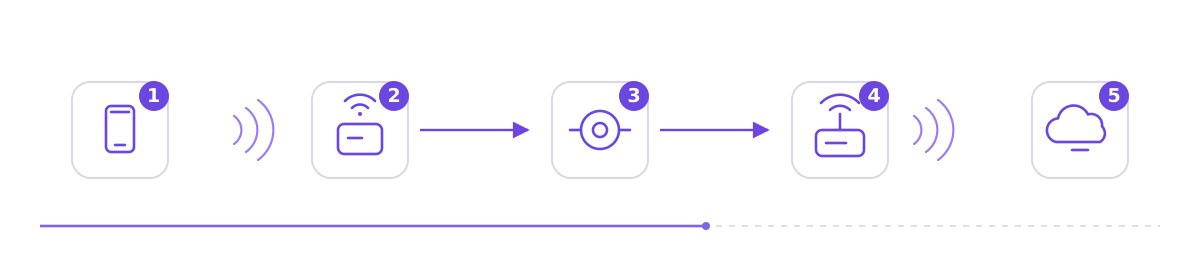
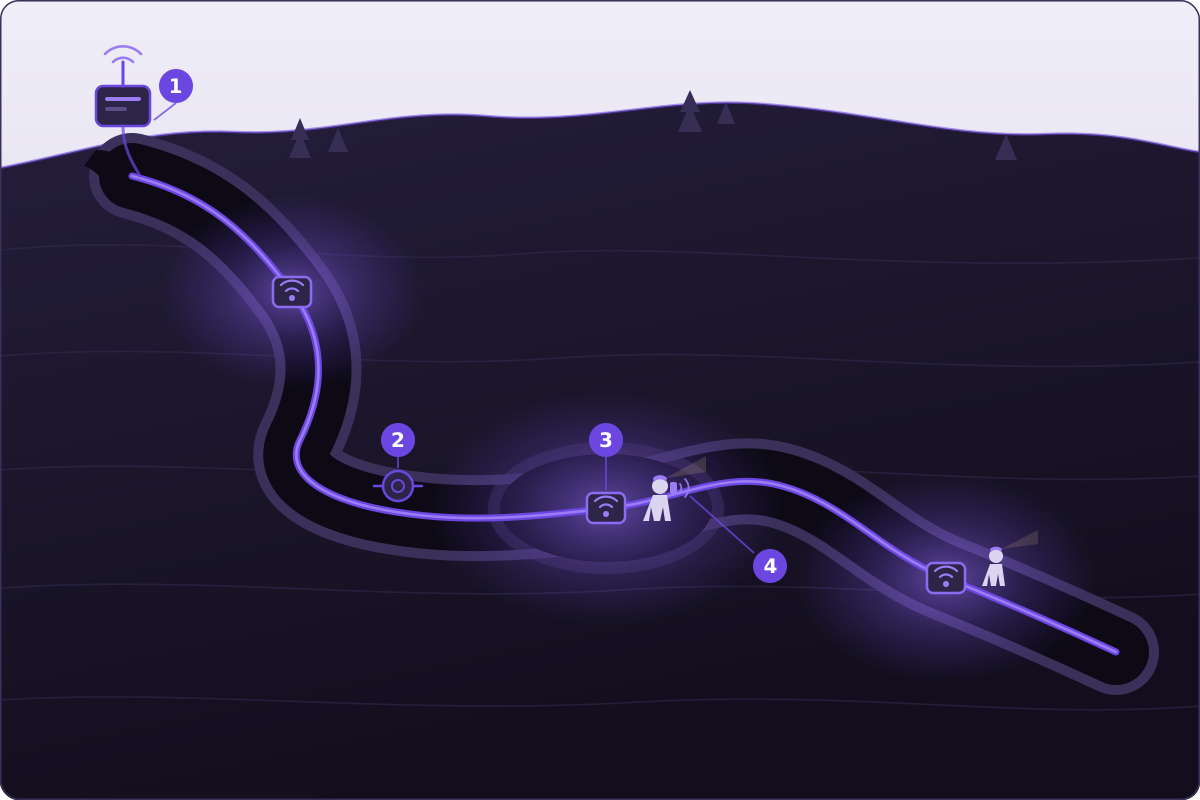
The deployment model is the part that changes what the system is for.
The fibre spools out behind the lead caver. Nodes go in where coverage is wanted: a chamber, a junction, the top of a pitch. The node’s own display shows link quality as you walk, and tells you when to stop.
The line is live as soon as the gateway sees it. Pushing deeper is a matter of more fibre and another node, not a new installation.
The line comes back with you, or stays if the site is being worked repeatedly. Either way, nothing has been drilled into the cave.
Publishing this matters more than a good specification sheet would. A team that finds a limitation underground has found it too late.
It is not a through-the-earth system — LoCave does not send a signal through solid rock. If there is no route for a cable — no connected passage, or one nobody is willing to pass — there is no link.
It does not replace a call-out plan — A communication line supports a rescue; it does not replace surface call-out arrangements, agreed return times, or the training and judgement of the people underground.
Coverage is where the nodes are — Coverage is where the nodes are. A caver away from any node’s Wi-Fi pocket is out of contact until they reach one. The nodes themselves talk to each other over fibre or, where no fibre is laid, over LoRa radio, which reaches further than a phone’s Wi-Fi but still needs the nodes placed within range of each other.
A cable is still a cable — Fibre is far tougher than it sounds and far lighter than copper, but it can be cut, crushed in a squeeze or pulled out by a rope. It is designed to be repaired in the field; it is not indestructible.
Send us the survey, the passage, or just the problem. We will tell you plainly whether LoCave is the right answer, including when it is not.