Underground communication

Reliable communication, deep underground.

LoCave combines short-range radio with rapid-deployment fibre optics, so research teams and rescue crews stay in contact through passages where no radio signal reaches the surface.

5×
Faster to lay
10×
Cheaper than VHF
3
Link types, one network
A LoCave node lying on the gravel floor of a cave, its display lit and a caver in a helmet crawling towards it in the background.
A LoCave node underground. The cave-facing display shows the last message received on the line; the other side shows the node’s link mode, battery and neighbours.
Why LoCave

Rock stops radio. It does not stop a cable.

LoCave does not try to push a signal through rock. It carries the signal along the passage on fibre, and turns it back into radio where people actually are.

Coverage where radio cannot reach

A few metres of limestone will stop a VHF signal that would cross open ground for kilometres. Running the link along the passage instead of through the rock removes the problem rather than fighting it.

Fast enough for a normal trip

The fibre is light enough to be paid out from a spool while the team moves in. LoCave puts that at around five times the pace of conventional cabling.

Cheap enough to use, not just to own

LoCave puts the cost at roughly a tenth of a comparable VHF installation. That is the difference between a system reserved for emergencies and one a club can actually use.

Ordinary handsets

No specialist radio to train on, carry or maintain. A phone joins the node’s Wi-Fi and opens a chat page. Nothing to install.

System

Four parts, one line

A LoCave installation is a fibre line with nodes on it, a gateway at the entrance and the LoCave cloud above ground. Nothing is drilled into the cave.

LoCave node

Coverage where the people are

A node sits in the passage and turns the fibre line into a pocket of short-range radio coverage, so a handset in that chamber can reach the surface.

  • Role Radio cell and repeater
  • Link Wi-Fi to handsets; fibre or LoRa onward
Radio Fibre

Fibre line

The backbone through the rock

Lightweight optical fibre, spooled out along the passage as the team advances and reeled back in on the way out.

  • Role Backbone
  • Link Node to node
Fibre Portable

Surface gateway

The link to the outside world

A computer at the entrance, connected by a USB cable to the first node. It keeps every message locally, shows the line on its own web page and passes the traffic to whatever network is available on the surface.

  • Role Entrance station
  • Link USB to the base node, surface network out
Fibre Surface

LoCave cloud

The trip, seen from above

A web dashboard for following deployments from anywhere: which nodes are up, what has been said, and a way to reply.

  • Role Management platform
  • Link Over the internet, from the gateway
Surface Web
Where it is used

Where it is used

Cave rescue

  • Written contact between the casualty site and the entrance
  • Coordination between underground teams without runners
  • A line that can be pushed deeper as the operation develops

Expeditions and research

  • Short notes and beacon readings out as they happen, without waiting for the exit
  • Survey and instrument data out without waiting for the exit
  • Fewer trips made purely to pass a message

Show caves

  • Staff communication along the visitor route
  • A way to reach a guide mid-tour
  • Coverage for incidents away from the entrance

Mines, tunnels and underground works

  • Communication along a working heading
  • A line laid as the works advance
  • Licence-free radio bands; national rules confirmed before deployment
How it works

From a handset in a chamber to the surface

Five stages. Radio at each end; in between, fibre where it is laid and node-to-node radio where it is not.
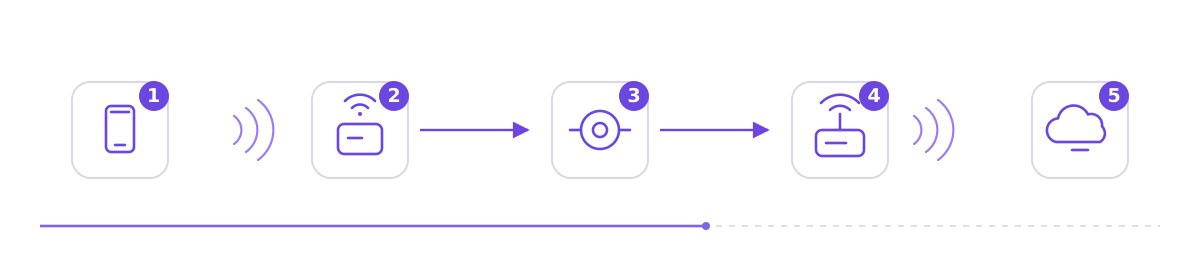
Five stages left to right: handset, node, fibre line, surface gateway, cloud.
Stages 1–3 are underground; the gateway and everything past it are on the surface.
  1. Handset — A caver’s phone joins the nearest node’s Wi-Fi and opens the chat page the node hosts.
  2. Node — The node takes the message off the air and puts it onto the line.
  3. Fibre line — The line carries it along the passage, over fibre where fibre is laid and node-to-node radio where it is not, past every bend, pitch and sump a phone’s signal could not.
  4. Surface gateway — At the entrance the line ends in a base node connected by USB cable to the gateway: a small computer that stores every message, shows the line on its own screen and passes the traffic to whatever network exists above ground.
  5. Surface and cloud — From there it reaches the surface team on the gateway’s screen, a Telegram group the gateway relays to, and the LoCave cloud dashboard, where the deployment can be followed and answered from anywhere with an internet connection.

The whole thing, in one drawing

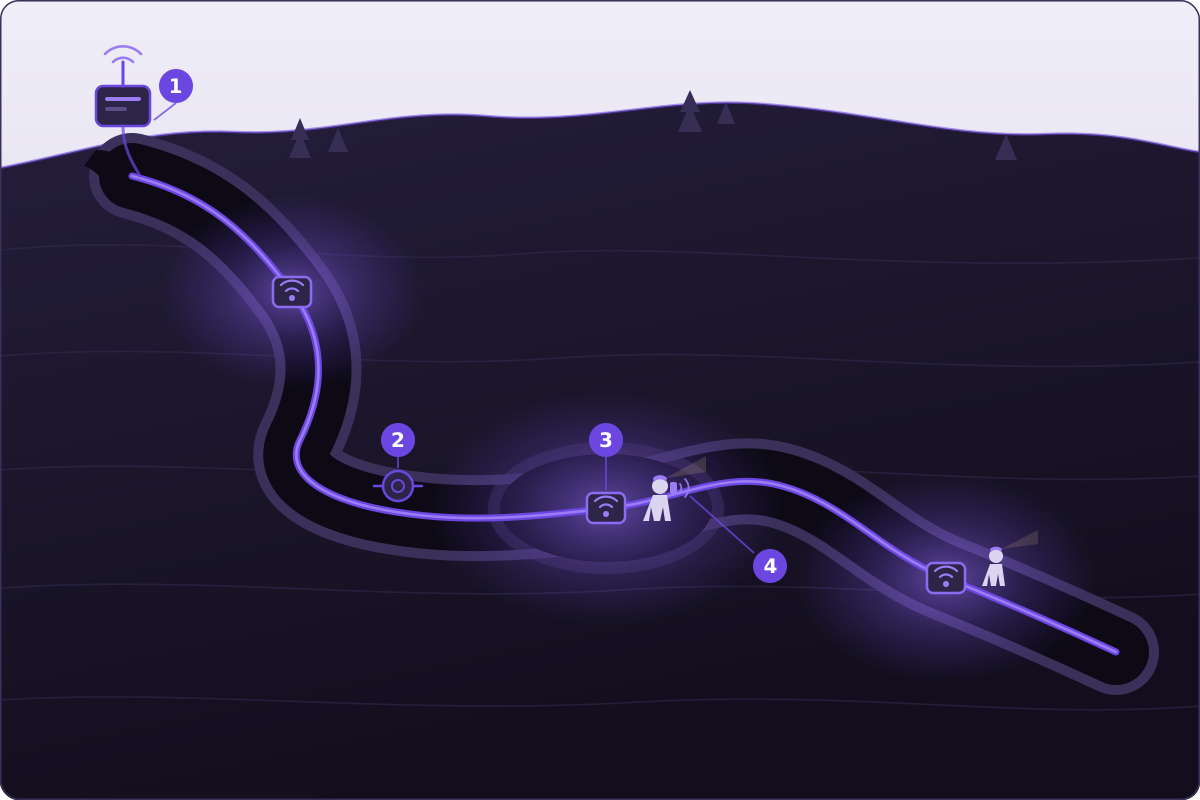
Cross-section of a cave: a surface gateway at the entrance feeds a fibre line down the passage, connecting nodes that each light a pocket of radio coverage for cavers deeper in.
  1. 1Surface gateway — at the entrance: a computer on a USB cable to the first node. It keeps everything, works offline, and joins the cave network to whatever network exists above ground
  2. 2Fibre line — spooled out along the passage as the team advances
  3. 3LoCave node — turns the fibre into a pocket of radio coverage, repeated along the line
  4. 4Handset — an ordinary smartphone, anywhere inside a node’s coverage

How can LoCAVE help you?

Send us the survey, the passage, or just the problem. We will tell you plainly whether LoCave is the right answer, including when it is not.

Get in touch